AN ARTISTS' COLONY -- THE UPHILL CLIMB TO
INSPIRATION
by Patricia Martin
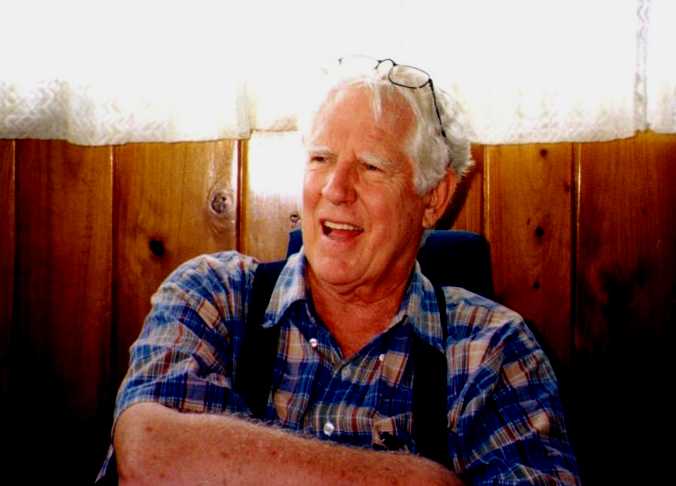
In the verdant hills of Costa Rica, 70 year-old Bill White prowls
his acreage, pausing at a look-out point to rest. While his eyes
scan the patchwork vista of farmland, town and forest spreading
to the far Poas volcano, his thoughts remain focused on his own
hillside. An artists' colony is about to come to life here. Today,
the American psychologist feels the resurgence of happiness - an
emotion long dormant in a man deeply scarred by grief.
 Beyond his
house, a new building awaits the arrival of the first two artists.
As though he has not done so all morning, he inspects the
premises, his lanky figure pacing the four sun-splashed
apartments. There are nods and grins. Both thumbs are hooked
through his suspenders in a telling gesture. "Over to the
right," he says in Spanish to the maid polishing the picture
window. "Perfect!" His sky-blue eyes are gleaming like
the glass.
Beyond his
house, a new building awaits the arrival of the first two artists.
As though he has not done so all morning, he inspects the
premises, his lanky figure pacing the four sun-splashed
apartments. There are nods and grins. Both thumbs are hooked
through his suspenders in a telling gesture. "Over to the
right," he says in Spanish to the maid polishing the picture
window. "Perfect!" His sky-blue eyes are gleaming like
the glass.
Writers and painters will occupy these studios for various terms
during the May-November artists-in residence program. Another
site has been cleared on the 17-acre compound for composers'
private cottages, well out of ear-shot. Still in the dream stage
are a theater and exhibition hall. Sponsored artists from any
country may enjoy the idyllic, tropical setting, with all costs
but airfare borne by Bill himself.
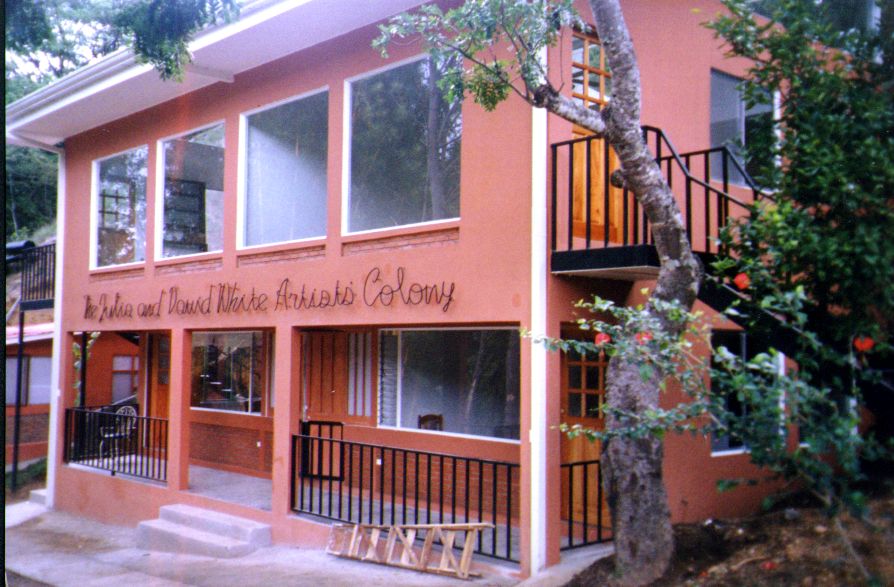
An enormous, wrought-iron sign dedicated to his only children is
now being installed on the building. THE JULIA AND DAVID WHITE
ARTISTS' COLONY. They will not be here for the formal
inauguration next month. Julia, 29, committed suicide four years
ago. David, 32, took a fatal dose of heroin 19 months later.
Amid ladders and drills, the momentous event is devoid of
ceremony. Workmen's concerns take precedence as the sign's
letters, measuring 36' x 2', are secured onto the new building.
When the task is finished, exclamations of triumph give way to
solemn tribute. A father's face grows quiet.
 During an interlude in
the morning's activities, Bill visits a secluded spot on the
compound where a tiny memorial building stands. There, an urn
holds the ashes of the manic-depressive young woman who leapt
from her 23-rd floor balcony in Washington state. Because David
was buried in Spain where he succumbed to his long addiction,
memorabilia take the place of his remains in the Costa Rican
shrine.
During an interlude in
the morning's activities, Bill visits a secluded spot on the
compound where a tiny memorial building stands. There, an urn
holds the ashes of the manic-depressive young woman who leapt
from her 23-rd floor balcony in Washington state. Because David
was buried in Spain where he succumbed to his long addiction,
memorabilia take the place of his remains in the Costa Rican
shrine.
Their lives are retold in a steady voice with long pauses. Both
were certified geniuses, gifted with a cornucopia of talents. He,
a virtuoso of woodwind instruments, composed and played for Los
Angeles ensembles; she graduated with honors from MIT in Astro-Physics
and Literature. After a few years in the scientific field, Julia
took leave to develop her play-writing skill, interning at the
Royal Court Theatre in London, England. Plays and poetry remained
her passionate endeavors until the end in 1994. Her works became
her father's legacy, while many of David's music manuscripts and
tapes have yet to be reclaimed.
Bill emerges from the memorial absorbed in thought. "You
know, as a father and psychologist, I was aware of Julia's mood
variations, but they seemed within normal range. If only she'd
been diagnosed earlier, then maybe....."
 After David's drug
detection, hopeful periods of rehabilitation ensued, only to end
in repeated relapse. In 1985, Bill co-founded a treatment program
in Los Angeles, named "SOS", for Save Our Selves, whose
effective methods have since been adopted in numerous countries.
Bill shakes his head. "The irony is that my own son couldn't
be one of the success stories."
After David's drug
detection, hopeful periods of rehabilitation ensued, only to end
in repeated relapse. In 1985, Bill co-founded a treatment program
in Los Angeles, named "SOS", for Save Our Selves, whose
effective methods have since been adopted in numerous countries.
Bill shakes his head. "The irony is that my own son couldn't
be one of the success stories."
On this day, it is the artist in each of them that their father
wishes to dwell upon. The colony symbolizes their continuance,
through the fostering of creativity in others. "A time to
celebrate," the arts patron declares.
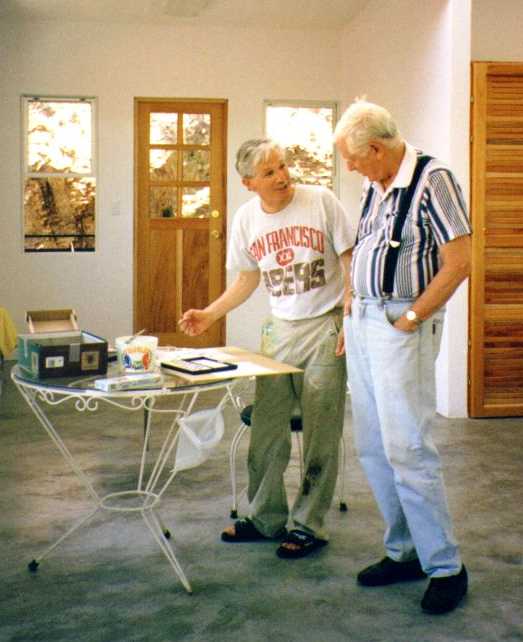
Someone approaches to announce the arrival of the two artists.
Bill closes the memorial door, adjusts his suspenders and
smoothes his white hair. Smiling, he strides forward to greet the
first residents with a warmth reminiscent of homecomings. They
cannot know the poignancy of the moment.
 After the
newcomers are shown around, they are given time to settle in
while their patron arranges lunch. Philip Higgs, a freelance
writer/researcher for the U.S. political publication "The
Nation," soon has his computer set up in the ground floor
apartment. The young man's mood is jubilant as he anticipates six
months dedicated to his embryonic novel.
After the
newcomers are shown around, they are given time to settle in
while their patron arranges lunch. Philip Higgs, a freelance
writer/researcher for the U.S. political publication "The
Nation," soon has his computer set up in the ground floor
apartment. The young man's mood is jubilant as he anticipates six
months dedicated to his embryonic novel.
Eager to swim in the pool, he calls to Joseph Piasentin in the
above apartment to join him. The painter and Fine Arts professor
from Malibu, California, challenges him instead to a game on the
tennis courts. Because of commitments back home, Joseph will
remain only six weeks at the colony. Their exchange is cut short
by a gong summoning them to lunch in the main house.
At the table, the spirited talk only falters for second helpings.
The "starving artist" notion does not apply here.
Joseph, whose abstracts are exhibited internationally, explains
that he will paint small schemes here, to be incorporated later
into his 6' canvases.
 Philip
proposes a toast to Bill, expressing what the colony means to him.
"Coming from the pressures and money worries of New York,
this is a dream. Now I'm a temporary member of the literary
leisure class!" Glasses clink to the sound of laughter.
Philip
proposes a toast to Bill, expressing what the colony means to him.
"Coming from the pressures and money worries of New York,
this is a dream. Now I'm a temporary member of the literary
leisure class!" Glasses clink to the sound of laughter.
The host is asked about his reasons for coming to Costa Rica in
1991 upon retirement. "It was the peaceful character of this
country that attracted me, not just its beauty. As you know,
Costa Rica has no armed forces - also no death penalty, and a
relatively low rate of violent crime."
A Georgia native, he had lived in various U.S. states before
settling in Los Angeles to pursue Psychology studies at U.C.L.A.
and The California Graduate Institute. A lifetime among artistic
people may have inspired the colony concept, but only with the
dual tragedy of his children did it assume form and meaning.
The profound impact of his loss is reserved for a private
conversation, out on the screened porch in a surround of boughs.
The need to return to it is evident, as though the last stages of
a grieving process demand reprise. His openness marks a change
from sitting in this same spot, numb and bewildered, barely
responding to consoling voices. In telling his story, Bill means
to impart hope of renewal to others.
"My grief over David had more to do with his life than his
death. I mean, here was a vital, talented person whose mind and
body were destroyed by drugs. When the news came - and I was
still reeling from Julia's suicide less than two years before -
he had been off drugs for some time, but he was already wasted.
After the initial shock, I felt some relief knowing his agony was
over."
Julia's violent death shattered her father. "We were always
so close. Despite her moods, she convinced me that her life and
career were going well." There was no final warning; neither
a precise reason given in the notes left behind, although the
pages indicate deep depression. Bill sifts through a compilation
of Julia's writings, choosing excerpts to read aloud from her
revealing poem "The Playwright"
What is true? What is real?
Eight months I've lived alone.
Eight months I have not spoken.
Eight months I've locked my craggy
Fingers tightly round my bluest pen
And written with a force that
Bears no description.
As if the sky were falling.
As if the sun would soon burn out.
As if my little life would soon come
Tumbling down into the dark-red sea.
What is true? What is real?
I have no future.
I have no dreams ahead.
I have the cold and steady
Knowledge of a life of bluer pens
And blanker pages and
Days more lonely than the last.
I have the skeletons inside me
Of a hundred thousand men and
Women waiting to come streaming
From my pen and dance and cry
And shake their fists at
The dying sun.
I have an idea about life.
What is true? What is real?
The skies open up and the
Waters shower out
Upon my up-turned head.
I have no future.
I have no dreams ahead.
But I have the rain
In my eyes and the
Earth beneath my feet.
I have my blue pen
And my blue heart
And my shaking white hands.
I have my walking shadows
And I have that quivering
Fragment of a notion unearthed -
Nothing true.
Nothing real.
Streaming eyes are dabbed. The poem is returned to the mound
of papers. "I'll be years sorting these, then I'll have them
published, along with what's left of David's music." He
brightens as his attention turns to his philanthropic enterprise.
"Just think of all the artists who'll benefit from the
colony..... all the creativity that's going to take place here."
On a peaceful, green hill where the spirits of his children abide,
Bill White's words are life-affirming. He has a future. He has
dreams ahead.